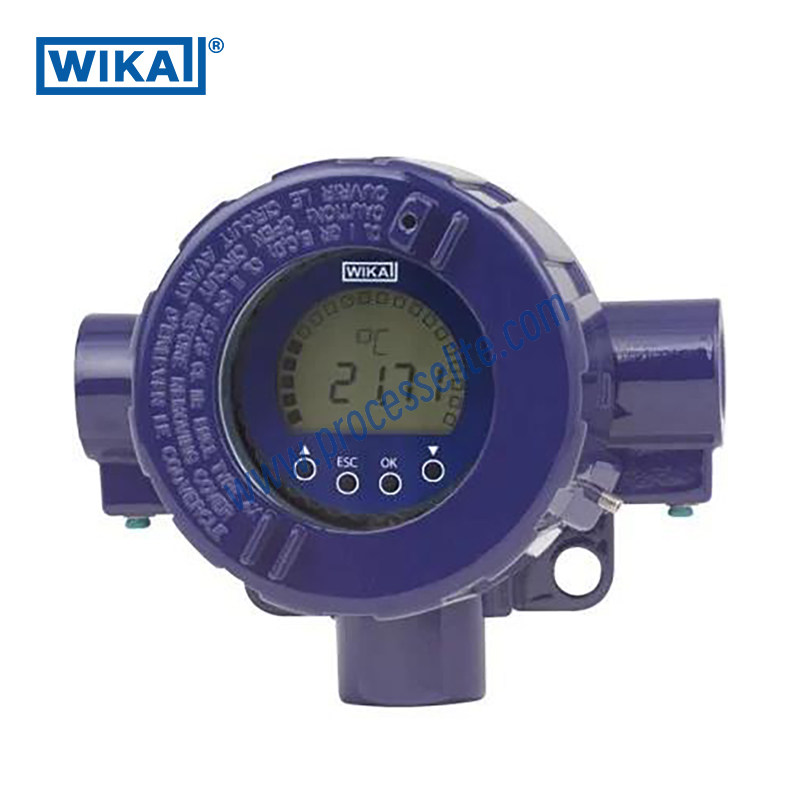
The core principle of a temperature transmitter is to convert the non-electrical quantity (temperature) sensed by a temperature sensor into a standard electrical signal. It connects to sensors such as thermocouples (TC) or resistance temperature detectors (RTD). For thermocouple signals, it performs cold junction compensation (to correct the influence of cold junction temperature changes), amplifies the weak thermoelectric potential, and applies linearization processing (since the thermoelectric potential is nonlinear with temperature). For RTD signals, it typically supplies power via a constant current source, converts the resistance change into a voltage change, and likewise performs linearization (since the resistance-temperature relationship is nonlinear). The circuit also filters the signal to suppress interference. The conditioned voltage signal is fed into a voltage/current conversion circuit (V/I converter), which precisely converts it into an industrial standard 4–20 mA DC current signal (or other standard signals). This current signal is linearly proportional to the measured temperature range, offers strong anti-interference capability, and is suitable for long-distance transmission to control systems.