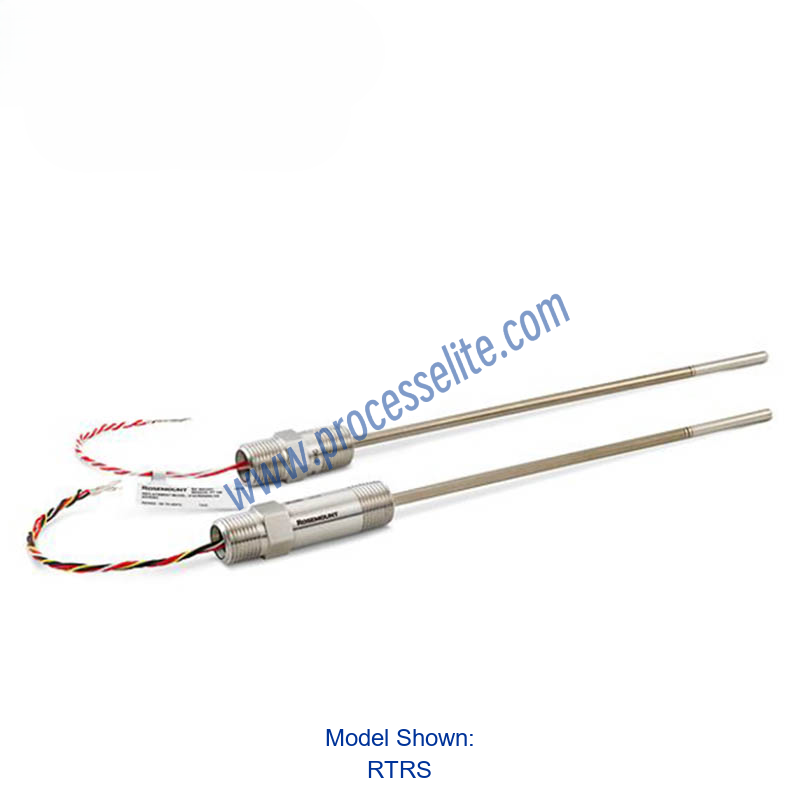
How it works
Temperature measurement by resistance thermometer sensors is realized based on the property that the resistance of metallic conductors varies with temperature.
Its core working principle is as follows: when temperature changes, the amplitude of lattice vibration of metallic conductors such as platinum and copper alters, which hinders electron movement to varying degrees and results in corresponding resistance variation.
Taking Pt100 platinum resistance as an example, its standard resistance is 100 Ω at 0 °C, and the resistance increases by approximately 0.385 Ω per 1 °C rise, presenting a highly linear relationship within a certain temperature range.
In practical measurement, constant current sources or bridge circuits are adopted to convert resistance variations into electrical signals. Three-wire or four-wire connection schemes are used to eliminate lead wire errors. Finally, resistance values are converted into temperature readings in accordance with international standard conversion tables.
Key features
RTDs feature high measurement accuracy and excellent long-term stability, suitable for medium and low temperature ranges (typically -200 °C to 850 °C).
They operate on the principle that the resistance of metals changes with temperature. Common sensing materials include platinum, copper and nickel. Among them, platinum resistance sensors such as Pt100 deliver the highest accuracy and can be applied in standard metering scenarios.
Nevertheless, they suffer from relatively slow response speed and bulky structure. In addition, they are susceptible to interferences such as vibration and corrosion from installation environments, so they must be equipped with protection sleeves.
Typical applications
Owing to their superior accuracy, RTDs are widely deployed in applications demanding high-precision temperature measurement.
In industrial sectors, they are commonly utilized for temperature monitoring of chemical reactors, temperature control on food processing production lines, and winding temperature detection of electrical power equipment such as transformers.
For scientific research, they serve as high-precision temperature sensing components for low-temperature laboratory environments, including refrigerators and cryostats.
In civil applications, they are adopted for temperature feedback in household appliances like air conditioners and water heaters, as well as ambient air temperature acquisition at environmental monitoring stations.